Infrared vs Traditional Sauna
The short answer. A traditional sauna heats the air to roughly 150 to 195°F, while an infrared sauna runs at a lower air temperature, about 110 to 135°F according to Cleveland Clinic, and warms you more directly. If you want steam and a hot room, choose traditional; if you want a smaller, plug-in cabin with gentler air, choose infrared.
How each type heats
A traditional sauna is a hot-room design. A heater warms stones or the air itself, and the room fills with dry heat. Harvard Health describes that dry heat as getting as high as 185°F, and its skin-temperature figure is worth knowing: within minutes your skin climbs to about 104°F. The cabin air does most of the work.
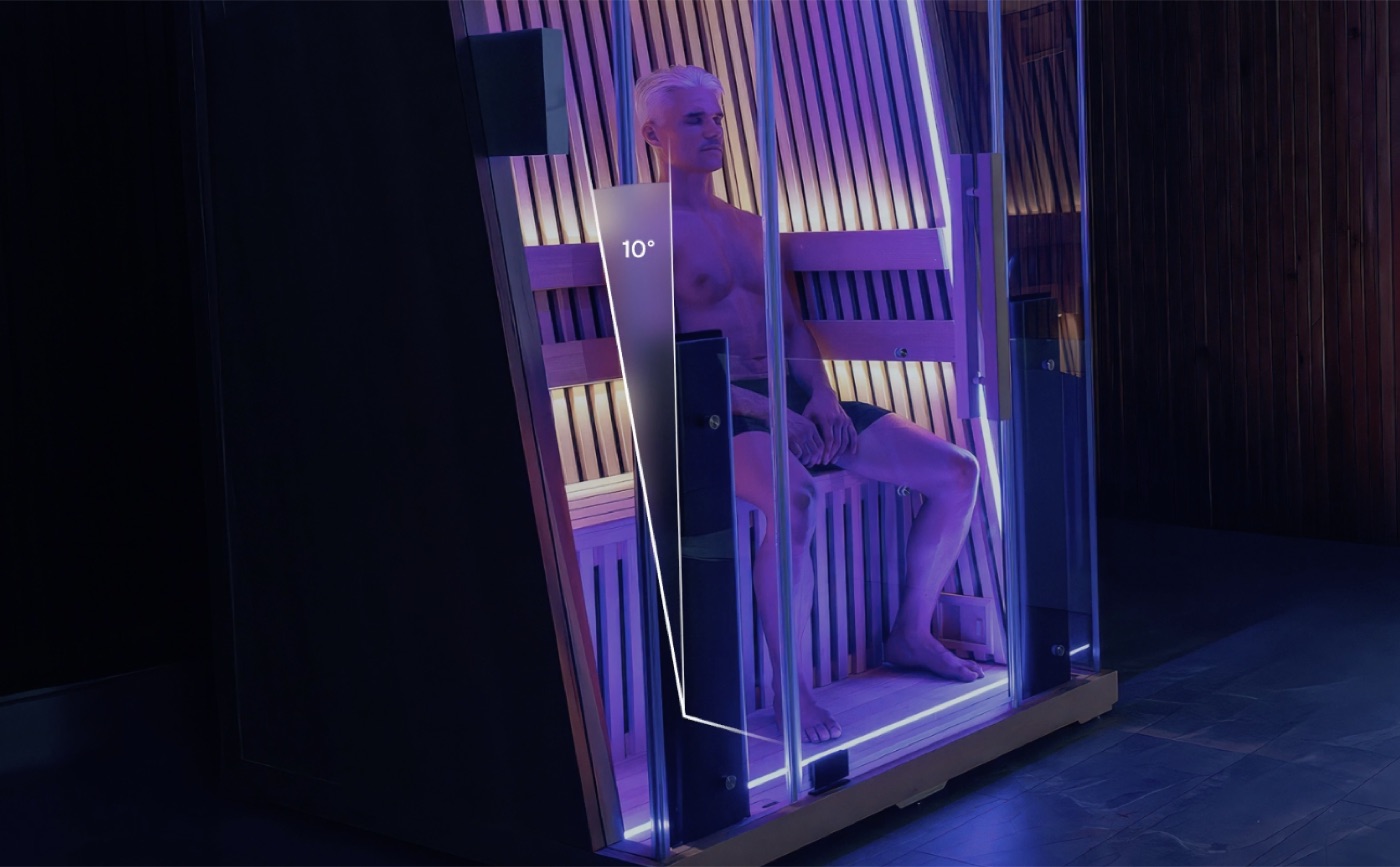
An infrared sauna works from a different idea. Instead of heating a large volume of air first, it uses infrared heaters, usually panels or lamps, that radiate warmth toward your body. The air in the cabin still warms up, but it does not need to reach traditional temperatures for you to feel hot and start to sweat.
That difference explains almost everything else in this comparison: the lower air temperature, the smaller cabins, the plug-in options and the way a session feels. It also explains why the two types are hard to compare on a single number. A 130°F infrared cabin and a 130°F traditional room are not the same experience.
If you want the detail on what the heaters themselves emit, read our guide to the full spectrum infrared sauna. It explains near, mid and far infrared and what a seller means by "full spectrum".
Temperature and what a session feels like
Cleveland Clinic gives operating ranges for both types: 110 to 135°F for infrared and 150 to 195°F for traditional. Harvard Health's own traditional-sauna figure, as high as 185°F, sits inside that range. Those are general ranges for the category, not a promise about any one product.
Here is how the numbers translate in practice.
- Traditional: the room is hot enough that breathing feels warm and dry. Many people find the upper bench intense and the lower bench milder.
- Infrared: the air feels moderate, and the warmth feels like it comes from the surface of the heaters. People often describe it as a deep, even heat rather than a blast.
A note on Plunge, since this site promotes it. Per Plunge, as read 2026-10-28, the Standard model reaches a maximum of 160°F and the Pro reaches 175°F. Both figures are higher than the 110 to 135°F range Cleveland Clinic gives for infrared saunas in general, so a Plunge cabin can be set well above what many infrared cabins are described as doing. These are Plunge's stated maximums, we did not measure them, and you can set the cabin lower. We also could not confirm the Pro's 175°F figure beyond Plunge's own page.
Session length
Both sources land in a similar place on time, and neither says more is better.
- Harvard Health advises no more than 15 to 20 minutes per session in a traditional sauna, and says to start with a few minutes when you are new to it.
- Cleveland Clinic suggests beginners start around 110°F for 5 to 10 minutes and keeps sessions to 20 to 30 minutes at most, even for experienced users, for infrared.
The pattern is the same: start low, start short, and leave when you feel unwell. Cleveland Clinic's example is dizziness or nausea.
SHOP THE PLUNGE INFRARED SAUNA →
Affiliate link: we earn a commission if you buy, at no extra cost to you. Details
Setup, power and space
Here the two types differ most for a home buyer.
Traditional saunas come in a few forms. Any heater that raises a room to 150°F or more also needs a suitable room or enclosure, with attention to ventilation and to the materials around the heater. Getting this right usually means a professional, and permits depend on where you live.
Infrared saunas are generally self-contained cabins. They are lighter on installation requirements because the heaters sit in the cabin walls and the room does not need to be built around a hot stove. Many arrive as a kit you assemble indoors.
Plunge's two models show how this plays out, per Plunge as read 2026-10-28:
| The Infrared Sauna (Standard) | The Infrared Sauna Pro | |
|---|---|---|
| Power | 120V outlet, plug-and-play | 240V, 20A dedicated circuit, NEMA 6-20 |
| Assembly | About 1 hour | About 1 hour |
That table matters because it tells you the real barrier. The Standard needs only a household outlet, while the Pro needs an electrician to run a dedicated 240V circuit if you do not already have one. If you rent, or do not want to add a circuit, that decides it.
On floor space, Plunge lists the Pro's two-person cabin at an exterior 53 1/8 in wide by 55 1/16 in deep by 79 in tall, and the three-person at 69 1/8 by 61 7/16 by 84 3/8 in. Plunge's standard-model page lists about 540 lb. A cabin that heavy is a floor-loading question for an upper story, so check your floor before you order.
A traditional sauna can take less or more room depending on the build. A small barrel or cabin kit is similar in footprint, and a built-in room can be sized to your space. Neither type is automatically smaller.
Running cost
Both types run on electricity (unless you choose a wood-fired traditional sauna), so the arithmetic is the same. Multiply the heater's power draw in kilowatts by the hours you use it, then by your electricity rate.
For the rate, the U.S. Energy Information Administration's Electric Power Monthly reported an average U.S. residential price of 18.16 cents per kilowatt-hour for August 2026, preliminary. Your local rate will differ, so look at your own bill.
Here is a worked example with an assumption we are stating plainly: a hypothetical heater that draws 1.5 kilowatts for a 30-minute session.
- 1.5 kW x 0.5 hours = 0.75 kWh
- 0.75 kWh x $0.1816 = about 14 cents per session
That wattage is an illustration, not a figure for any product. Plunge's pages as we read them did not give a power draw in a form we could use, so we do not print one. Check the spec sheet of any sauna you are considering for its rated watts.
What changes the real cost is not the sauna type itself:
- Warm-up time. A sauna that must heat a large volume of air or a mass of stones runs for a while before you get in. A cabin that warms quickly uses less before the session starts. We did not find a sourced warm-up figure for either type, so ask the seller for one and ask how it was measured.
- Session temperature. A higher set point draws more power for longer.
- How often you use it. Three sessions a week costs about three times one.
For a full breakdown of purchase price, delivery, assembly and financing, see our guide to infrared sauna cost.
Maintenance
Neither type is demanding, but they ask for different habits.
- Traditional: a hot room with wood benches and walls needs ventilation and time to dry after use. Check the heater maker's care instructions.
- Infrared: there are no stones and no steam, so there is less moisture to manage. You wipe the benches, keep the glass clean and let the cabin air out.
For any wooden cabin, wipe sweat from the benches and leave the door ajar afterward so the wood dries. Plunge says its cabin is Canadian hemlock; we cannot speak to how any wood holds up over years.
Plunge states warranty tiers per its pages as read 2026-10-28: 5 years on cabinetry and heaters, 2 years on electronics and controls, 1 year on glass and power supplies, plus an optional 2-year extended coverage. Warranty length tells you what the seller will stand behind, not how long the product will last in your home.
Safety for both types
Most of the guidance is shared, and it applies whichever you pick.
- Hydrate. Harvard Health notes the average person sweats about a pint in a short sauna session, and recommends two to four glasses of cool water afterward. Cleveland Clinic says to bring water.
- Skip alcohol. Both Harvard Health and Cleveland Clinic advise against it before or during a session.
- Do not use a sauna while sick. Both advise avoiding it when you are ill or have a fever.
- Cool down gradually, and leave at once if you feel dizzy or nauseated.
- Ask a doctor first if you have a medical condition. Harvard Health says people with uncontrolled high blood pressure or heart disease should check with their doctor. Cleveland Clinic says people with multiple sclerosis, people who are pregnant and people trying to conceive should avoid or use caution with infrared saunas.
If you take medicines, ask your doctor or pharmacist whether heat could affect them. Harvard Health specifically cautions about medications that impair sweating.
Cleveland Clinic's point that hotter is not necessarily better is a useful one for this decision. It means a lower-temperature infrared cabin is not a lesser product and a hotter traditional room is not a better one. For what research does and does not show about either, read our infrared sauna benefits guide.
Who should pick which
Choose traditional if:
- You want hot, dry air.
- You have a space designed for it, or you are building one, and you are comfortable with installation work.
- You like a social room that fits several people on benches.
- You are comfortable with higher temperatures and shorter sessions.
Choose infrared if:
- You prefer gentler air temperatures and a cabin you can assemble yourself.
- You live somewhere without room for a hot-room build.
- You want a plug-in option (the Standard model per Plunge) or a dedicated-circuit option for more output (the Pro).
- You want the electronics: app control, scheduling and preheating, which Plunge lists for its cabins.
Look elsewhere for both if your budget is under roughly $3,000 (Plunge's prices as read are well above that), if you want an outdoor install, or if you want a blanket or a portable tent. Those are different products, and this site does not cover them.
If you are still weighing models, our pick is covered on the page about the best infrared home sauna, and the details of the Plunge cabins are on the Plunge infrared sauna review.
Where Plunge fits
We promote Plunge and earn a commission if you buy through our link, at no extra cost to you. That affects what we choose to cover, so weigh it when you read us.
SHOP THE PLUNGE INFRARED SAUNA →
Affiliate link: we earn a commission if you buy, at no extra cost to you. Details
Plunge makes infrared saunas only, so it is relevant only if you decided on infrared. Per Plunge, as read 2026-10-28, the Standard is $7,190 (was $7,690) on a 120V outlet and the Pro is $7,490 ($7,990 crossed out) on a dedicated 240V, 20A circuit. Plunge also lists a $500 automatic discount, a complimentary extended warranty ($399 value) and 0% APR financing for up to 36 months through Bread Pay, subject to credit approval. Offers change, so confirm them on Plunge.
Plunge states a near-zero EMF rating (0.1 mG per its Trifield reading). That is Plunge's statement, we did not verify it, and our guide to low EMF infrared saunas explains how to read a claim like it.
Plunge's pages as we read them did not state a trial period or a return policy. Read the policy at checkout before you pay.
It suits you if you want infrared, can pay about $7,000 to $8,000, and can use a 120V outlet or add a 240V circuit. Look elsewhere if you want a traditional sauna, an outdoor build or a lower price.
FAQ
Is an infrared sauna hotter than a traditional sauna?
No, not in air temperature. Cleveland Clinic gives 110 to 135°F for infrared saunas and 150 to 195°F for traditional ones. Some products, including Plunge by its own stated maximums, can go higher than the typical infrared range.
Which is cheaper to run?
It depends on wattage, warm-up time and how long you stay in. Multiply the rated kilowatts by hours and your rate. The EIA reported 18.16 cents per kilowatt-hour as the U.S. residential average for August 2026. We found no sourced warm-up figure that favors one type, so compare the specs of the specific models.
Which is safer?
Neither is automatically safer. Hydration, avoiding alcohol, keeping sessions short and asking a doctor about medical conditions apply to both. Heat exposure carries real risks for some people, including those who are pregnant, so ask a doctor before you start.
How long should I stay in?
Harvard Health suggests no more than 15 to 20 minutes in a traditional sauna. Cleveland Clinic suggests 5 to 10 minutes for infrared beginners and no more than 20 to 30 minutes for anyone. Leave sooner if you feel unwell.
Can I put a sauna in an apartment?
An infrared cabin that plugs into a standard outlet is the practical choice, subject to your lease and your floor's weight limit. Plunge's Standard is listed as plug-and-play 120V, and Plunge's page lists about 540 lb. Check your lease and your floor first.
Do I need an electrician?
For a plug-in 120V cabin, usually not. For a 240V cabin such as the Plunge Pro, which needs a dedicated 20A circuit per Plunge, an electrician typically does that work. Traditional electric heaters also commonly need a dedicated circuit, so check the rating on the one you want.
Key takeaways
- Traditional saunas run about 150 to 195°F; infrared saunas about 110 to 135°F (Cleveland Clinic).
- Session guidance is short and cautious for both types: 15 to 20 minutes (Harvard Health) to 20 to 30 minutes at most (Cleveland Clinic).
- The practical difference is setup. Infrared is self-contained; traditional needs a space built for it.
- Running cost is rated kilowatts times hours times your rate; it is usually small per session.
- Plunge's stated maximums (160°F Standard, 175°F Pro) exceed the typical infrared range.
- Anyone with a medical condition, pregnancy or regular medicines should ask a doctor first.
Sources
- Cleveland Clinic, "Infrared Sauna Benefits" (operating temperatures, session length, who should avoid, safety tips), https://health.clevelandclinic.org/infrared-sauna-benefits, read 2026-10-28
- Harvard Health Publishing, "Saunas and your health" (traditional sauna temperature, session length, hydration, cautions), https://www.health.harvard.edu/heart-health/saunas-and-your-health, read 2026-10-28
- U.S. Energy Information Administration, Electric Power Monthly, Table 5.6.A (average residential price, August 2026, preliminary), https://www.eia.gov/electricity/monthly/epm_table_grapher.php?t=epmt_5_6_a, read 2026-10-28
- Plunge, product pages (specs, prices, offers, warranty; as read, stated by Plunge), https://plunge.com/products/the-infrared-sauna and https://plunge.com/products/the-infrared-sauna-pro, read 2026-10-28